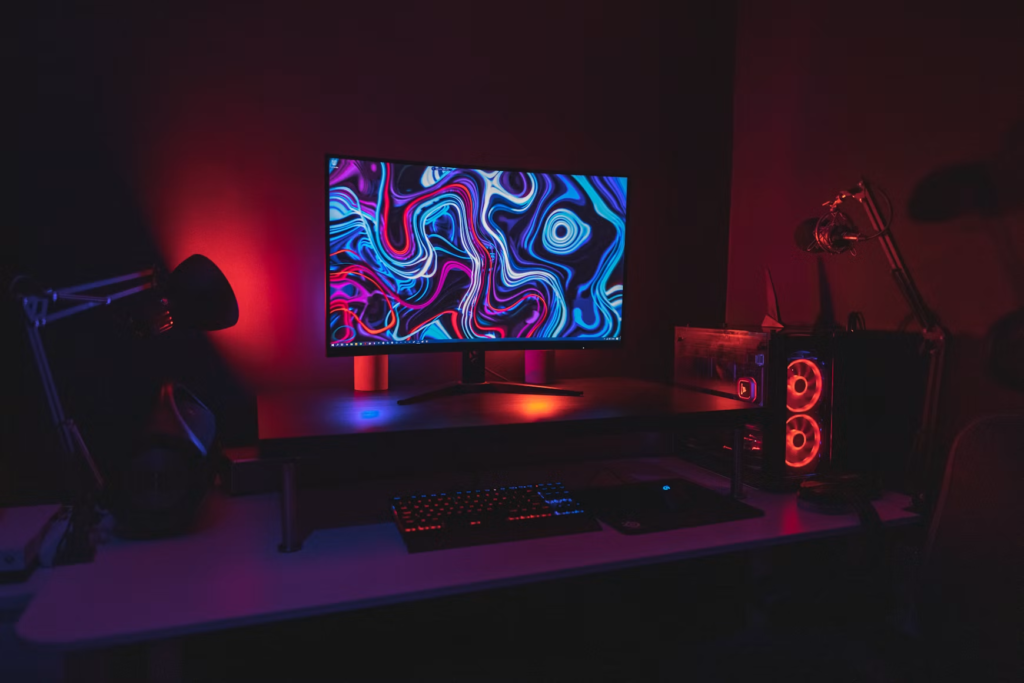

Early video games impressed by virtue of movement alone, yet polygon walls and flat shadows soon revealed clear limitations. Today’s audiences expect cinematic visuals on demand, and ray tracing technology now delivers reflections, refractions, and global illumination that rival live-action footage. By simulating the physical behaviour of light instead of faking it with tricks, developers craft digital worlds where every sparkle, puddle, and windowpane responds convincingly to surrounding objects.
Second-paragraph discussions of next-generation graphics often focus on flagship demonstrations. Recent marketing for the tower rush game app highlights crystal-clear particle effects and dynamic sunsets as major selling points, proving that realistic lighting can carry an entire promotional campaign – even for a mobile title competing against console heavyweights.
Why Ray Tracing Provides a Leap, Not a Step
Rasterization, the long-standing standard, renders one frame as a collection of triangles, textures, and baked shadows. Ray tracing, by contrast, tracks millions of virtual photons, allowing light to bounce, scatter, and color surfaces in a physically faithful manner. The resulting depth fools the human eye into forgetting that a GPU produced the scene rather than a camera.
Key Visual Upgrades Delivered by Ray Tracing
- True-to-Life Reflections
Water, glass, and polished metal mirror nearby geometry with pixel-accurate precision, removing distracting approximation artifacts. - Soft, Contact-Based Shadows
Objects cast blurred or sharpened shadows based on distance to the surface, mimicking familiar real-world penumbra effects. - Sub-Surface Scattering
Skin, wax, and foliage glow gently when backlit, conveying organic translucency that standard shaders struggle to emulate. - Color Bleeding Between Surfaces
Light picks up hue information as rays bounce, so a red rug softly tints adjacent walls, enhancing environmental cohesion. - Volumetric Lighting and God Rays
Fog and dust shafts filter sunlight authentically, providing atmospheric storytelling tools that previously required heavy artist tweaking.
Each improvement strengthens immersion, prompting strategic players to read environments intuitively—such as tracking opponents via accurate reflections in a corridor or predicting stealth opportunities by watching shadow gradients.
Hardware Evolution Opens the Door
Specialized ray-tracing cores inside contemporary GPUs accelerate photon calculations that once demanded server-grade workstations. Console manufacturers responded by embedding similar silicon in mainstream systems, allowing mid-priced living-room hardware to run effects once reserved for Hollywood render farms. As silicon processes shrink, dedicated acceleration consumes less power, enabling laptops and eventually handheld devices to join the high-fidelity club without thermal throttling.
Game engines keep pace by offering real-time hybrid renderers. A scene may still rely on traditional raster passes for geometry while a post-process layer adds path-traced lighting, balancing fidelity and frame-rate targets. Middleware such as deep-learning super-resolution further rescues performance by upscaling lower-resolution ray-traced images, cutting computational cost in half while preserving detail.
New Creative Possibilities for Designers
Photorealistic lighting shifts game design philosophy. Artists place practical fixtures—lamps, neon signs, glowing mushrooms—in logical positions and watch the engine handle illumination automatically. Level designers embrace darker environments because players can now navigate by subtle ambient cues instead of exaggerated brightness. Horror titles lean on faint reflections in puddles to foreshadow lurking dangers, while racing simulations gauge driver skill by how well road glare is managed.
Challenges Studios Must Overcome
Production Barriers Still Facing Widespread Adoption
- Performance Overhead
Even with cutting-edge silicon, full path tracing on ultra-high resolutions pushes hardware to the brink, forcing studios to offer multiple quality modes. - Content Creation Load
Artists must craft high-detail materials and geometry, as low-quality assets appear more obviously fake under realistic lighting conditions. - Testing Complexity
Subtle lighting bugs, such as light leaks through thin walls or flickering caustics, require meticulous QA passes that lengthen production timelines. - Compatibility Limitations
Older consoles and entry-level PCs lack dedicated ray-tracing units, so fallback pipelines must coexist, doubling some engineering work. - Player Expectation Escalation
As audiences become accustomed to lifelike visuals, tolerance for stylistic shortcuts drops, challenging indie teams with limited budgets.
Addressing these hurdles demands clever optimization strategies, modular asset libraries, and scalable lighting presets that adjust gracefully across device tiers.
Future Outlook Beyond Traditional Displays
Ray tracing’s influence extends into virtual reality, augmented reality, and cloud gaming. Head-mounted displays benefit from heightened depth cues, reducing motion sickness by matching vestibular feedback to consistent visual geometry. Cloud platforms, relieved of local hardware limits, run brute-force path tracers on server clusters, streaming pristine frames to thin clients worldwide. Meanwhile, academic researchers investigate blending ray tracing with real-time radiosity and neural rendering, hinting at scenes where every photon interaction is physically perfect.
Consumer adoption follows a recurring pattern: early adopters demand ultra fidelity, hardware manufacturers chase that demand, and economies of scale lower prices. Within a decade, realistic lighting may become a default expectation akin to high-definition textures today.
Conclusion
Ray tracing replaces decades of artistic compromise with a mathematically robust representation of light, transforming modern games from stylistic cartoons into near-cinematic experiences. By generating accurate reflections, subtle shadows, and nuanced color interplay, the technique anchors virtual spaces in a believable framework that enhances both gameplay clarity and emotional resonance.