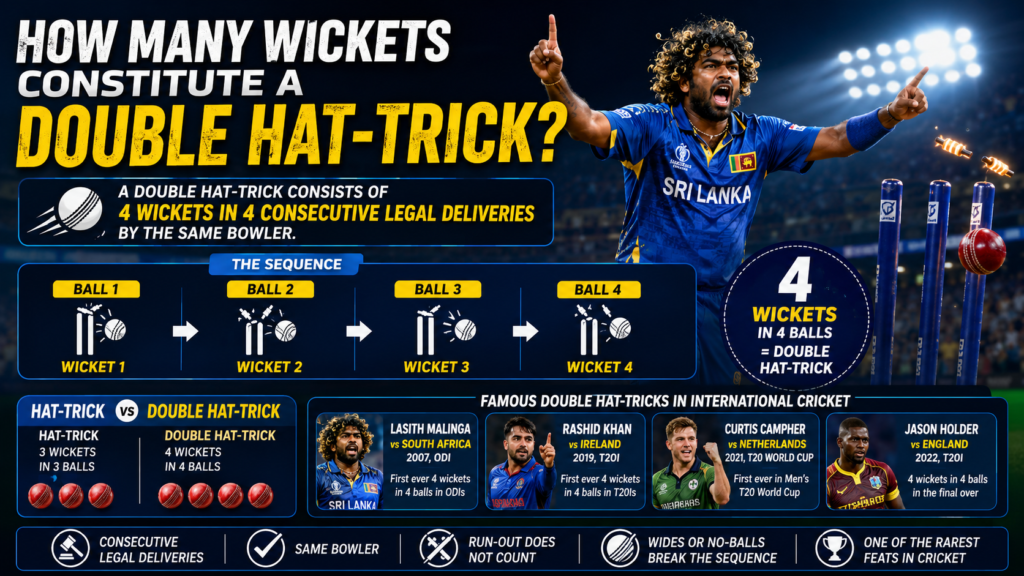

In case you are asking how many wickets makes a double hat trick? There are different ways that a bowler can take four wickets without being niggardly by the use of no-balls. The simplest answer is to have one bowler claim four in four (with other hammerings) but all off deliveries deemed legal.
Three wickets in three consecutive balls is known as a normal hat-trick. One more dismissal adds the sequence to that list, but a double hat-trick makes it one of the rarest bowling feats in cricket.
But there are nuances: “double hat-trick” is an informal cricket phrase, not a strict category according to the MCC Laws of Cricket. In factual statistical parlance, this performance is best described as four wickets in four balls. The term has found usage among broadcasters, players, commentators and fans.
The achievement has occurred several times in the history of international cricket. Lasith Malinga holds the distinction of being the first bowler in an ODI to take four wickets in four balls, which he achieved during the 2007 Cricket World Cup; Rashid Khan, Curtis Campher and Jason Holder are among those who have memorable four-in-four spells in T20I cricket.
How Many Wickets Are in a Double Hat-Trick?
Four wickets in four successive legitimate balls is known as a double hat-trick。
So be at your utmost simplicity:
| Bowling Feat | Wickets | Deliveries |
| Hat-trick | 3 | 3 consecutive legal balls |
| Double hat-trick | 4 | 4 consecutive legal balls |
| Five wickets in five balls | 5 | 5 consecutive legal balls |
| Six wickets in six balls | 6 | 6 consecutive legal balls |
As an example: if a bowler takes four batters out with four legal deliveries in a row this is often regarded as a double hat-trick.
Double may be a misleading word for new cricket fans. That does not mean the bowler has to take six wickets. Rather, four wickets in as many balls present two competing three-wicket timelines: (1) a hat-trick across balls 1 to 3 and (2) another three-wicket timeline across balls 2 to 4.
What Is a Regular Hat-Trick?
To understand a double hat-trick, it helps to first know what a normal hat-trick is.
In cricket, a bowler is said to have taken a hat-trick when they dismiss three batters with three normal legal deliveries.
For example:
- Ball 1: Batter A is bowled.
- Ball 2: Batter B is caught.
- Ball 3: Batter C is out LBW
That is a hat-trick.
Now suppose he takes one more wicket with the next legal delivery bowled by that same bowler:
- Ball 4: Batter D is bowled.
Bowler has now taken four in two balls and this is normally called a double hat-trick.
Why Is a Double Hat-Trick So Rare?
It is not easy to hit three blokes in three balls. It’s even more difficult to take a fourth one for two significant reasons; the batter, captain and fielding team know taking another will create history.
Something which is required by a bowler is a mix of:
- Accuracy
- Variation
- Pressure control
- Good field placement
- Batting mistakes
- A little luck
- Excellent execution
The bowler must also send four separate batters back to the wickets, without a non-wicket delivery interrupting the run.
Which is why four wickets in four balls continues to be an all-time great achievement.
What Counts as a Legal Delivery?
The term “consecutive” is vital.
Here, four of these wickets should come from the same bowler who will be shown with a unique number and in consecutive legal deliveries. If the ball is wide or no-ball then it will not be a legal delivery that leads to this not count as one of the four in sequence.
For example:
- Legal ball – wicket
- Legal ball – wicket
- Wide – no wicket
- Legal ball – wicket
- Legal ball – wicket
This wouldn’t be four wickets in four legitimate deliveries because the sequence has been broken by the wide.
Also, if [the bowler] takes wickets on good balls but a run-out falls in between those balls, then that [run-out] is not a wicket attributed to the bowler and therefore is not in counts within the four-wicket sequence.
Which Dismissals Count Toward a Double Hat-Trick?
Double hat-trick (based on wickets attributed to a bowler)
Normal dismissals which may count include:
- Bowled
- Caught
- LBW
- Stumped
- Hit wicket
- Caught and bowled
Bowler’s wicket → A run-out does not!
That is significant because there are a number of methods of dismissal in cricket, but not all of those dismissals go down against the bowler.
E.g a bowler takes two wickets, then a run-out, then two more wickets does not mean the bowler has taken four wickets in four balls.
Can a Double Hat-Trick Happen Across Two Overs?
Yes.
It is not necessary for the four wickets to come in a single over.
One of the well-known instances is Lasith Malinga taking four wickets in November 2007 against South Africa at the 2007 Cricket World Cup. He secured his initial two wickets with the last two balls of one over, and then took another two in the first 2 balls of his next over.
The sequence was:
- Ball 1: Shaun Pollock – WICKET
- Ball 2: Andrew Hall – wicket
- Ball 3: Jacques Kallis – out
- Ball 4: Wicket of Makhaya Ntini
That is how Malinga became the first bowler to take four wickets in 4 balls in an ODI.
It is for this reason that it matters how many deliveries you face on each particular over, rather than whether the delivery occurs or not since one is very close to the other.
Can a Double Hat-Trick Cross Innings?
The key point is that the four wickets should come in consecutive deliveries from a single bowler during the same match.
When the bowler comes back to bowl later, a sequence can only continue if they have bowled that number of consecutive deliveries required under the scoring sequence as it stands. The wickets in a match are not the only thing that makes it an appealing choice; they also have to be back-to-back deliveries of that bowler.
But this is infinitely more rare and nowhere as simple as four-in-four in an over.
The simple definition is still generally four wickets in four balls legally delivered by the same bowler.
Famous Double Hat-Tricks in International Cricket
Many bowlers have bowled spells of four wicket hauls in four overs on the international platform.
1.Lasith Malinga – Sri Lanka
The most iconic example remains Lasith Malinga’s 2007 World Cup show.
Sri Lanka were on the verge of defeat against South Africa in the first half of October 2023, played at Guyana. With five wickets in hand, South Africa required only four runs.
What followed was one of the greatest bowling spells in World Cup history by Malinga.
He removed Shaun Pollock, Andrew Hall, Jacques Kallis and Makhaya Ntini in successive deliveries.
Malinga’s achievement is considered by the ICC as the first-ever four wickets in four balls in an ODI.
South Africa, however, held their nerves to sneak home one wicket win against Malinga’s brilliance.
The episode is still extraordinary because Malinga nearly reversed an apparently lost match in four balls.
2.Rashid Khan – Afghanistan
Afghanistan spinner Rashid Khan picked up 4 wickets in successive balls against Ireland during a T20I at Dehradun in the year of 2019.
It was part of his five wickets, Chris Woakes took 5 wickets in the match to hand Afghanistan a series win.
Rashid’s accomplishment was unprecedented as he became the first bowler in T20I history to take four wickets off four balls. In fact, at the close of 2020, this particular accomplishment was featured when named the Men’s T20I Cricketer of the Decade by ICC.
3.Lasith Malinga, Sri Lanka again
Later in 2019, Malinga did it again with four-in-four.
In a T20I at Pallekele, the victims were batters of New Zealand Malinga sent Colin Munro, Hamish Rutherford and Colin de Grandhomme back to the dugout in four successive deliveries before Ross Taylor was gone on the next ball.
Malinga became the only bowler in one-day history to capture four wickets in four consecutive balls in ODIs and T20Is.
That is an incredible stat because it tells he did so in two international formats.
4.Curtis Campher – Ireland
In the ongoing 2021 ICC Men’s T20 World Cup, Ireland’s Curtis Campher achieved another four in four milestone against the Netherlands.
Campher dismissed:
- Colin Ackermann
- Ryan ten Doeschate
- Scott Edwards
- Roelof van der Merwe
Campher got in the action with his spell of four wickets and ICC stated that it left the Netherlands at 51 for six.
And it was an even greater achievement that Campher is the first player to take four wickets in four balls in a Men’s T20 World Cup match.
When the same first three men were HUK’s Campher, Malinga and Rashid Khan, the ICC would later call them “the first three men to take four wickets in four balls in men’s T20Is.
5.Jason Holder – West Indies
Another legendary four-in-four comes via Jason Holder, in January 2022.
In the T20I against England, Holder picked up 4 wickets in 4 balls in the last over at Bridgetown.
His victims were:
- Jason Roy
- Sam Billings
- Chris Jordan
- Adil Rashid
Holder ended with 5/27 and he was supported by the four in four run made WIndies win by 4th match and T20I series won by West Indies (3 – 2). This was corroborated by the ICC in its match report.
That also made Holder the third West Indian men’s player to claim a T20I hat-trick.
Double Hat-Trick vs Hat-Trick
The difference is simple:
| Feature | Hat-Trick | Double Hat-Trick |
| Wickets | 3 | 4 |
| Deliveries | 3 | 4 |
| Consecutive? | Yes | Yes |
| Same bowler? | Yes | Yes |
| Legal deliveries? | Yes | Yes |
| Run-out counts? | No | No |
| Official MCC term? | Hat-trick is widely established | Double hat-trick is informal |
It separates the two landmark milestones by the fourth wicket.
A hat-trick is when a bowler dismisses three wickets off three balls. If he then takes another wicket with the very next legal ball, that’s four in four balls for his spell.
Is “Double Hat-Trick” an Official Cricket Term?
This is one of the crucial points for cricket writers and fans alike.
Double hat-trick is not defined as an official category by the MCC Laws of Cricket. It has become a commonly used phrase that indicates four wickets in as many balls on one of the many betting forms.
This was an instance of four wickets in four balls that the ICC itself also regularly speaks of while reporting such performances.
This is where the ICC described Malinga’s 2007 performance as four wickets in four balls, though not all four were taken by him in the same over; and this week they said that he had ‘achieved’ it three more times: most recently in 2019, when he took four wickets in four successive balls.
So if you absolutely want to be technically correct, write:
Four wickets in four successive legal deliveries, otherwise known as a double hat-trick.
Is Six Wickets in Six Balls a Double Hat-Trick?
For instance, in common modern cricket lexiconnah.
Others among us rightly note that a “double” hat-trick, at least in fan-speak, must involve two full hat-tricks, one requiring six wickets (in six balls) to count.
But that is not how the word is typically used in cricket.
The widely accepted meaning is:
Double hat-trick= four wickets in four successive balls
Double hat-trick would actually mean a six-wicket sequence, not nowadays’ standard double-hat trick – some sort of special “six in six” achievement.
And there is also a quite nice mathematical reason for that. Four in four includes two overlapping three-ball sequences:
- Wicket 1 + Wicket 2 + Wicket 3 = hat trick
- Wicket 2 + Wicket 3 + Wicket 4 = yet another hat-trick
So is the reason for a cricketing term — double hat-trick.
Why Malinga’s Record Is So Special
The fact that it occurred in a World Cup and when South Africa needed four runs to win highlights the significance of Malinga’s achievement.
Malinga achieved this remarkable feat back in 2007 and according to ICC, since then his four wickets in four balls from that World Cup remained the only four-in-four performance in ODI cricket.
The achievement was also made more notable due to his style of bowling.
Malinga was known for his quirky sling-arm action and that death over yorkers. He beat tried and tested international batters with a mix of deliveries in that four-ball sequence.
It was even more dramatic as South Africa narrowly survived with the win by 1 wicket.
How Rare Is a Double Hat-Trick?
A regular hat-trick is rare. A four-in-four is significantly rarer.
The ICC’s documentation gives you a glimpse as to how rare the achievement is in international cricket over various formats. For years, Malinga’s ODI achievement remained isolated before T20I cricket produced a handful of four-in-four efforts.
Because batters are almost always under attack in T20 cricket, it likely opens up more windows for such explosions (SNAP!) an increase in opportunity for catches, bowled and poor-times shots.
Nevertheless, the bowler would still have to bowl four good balls in a row.
One mistake ends the sequence.
What Happens If a Wide Occurs?
Let this sequence be something like :
- Ball 1 – wicket
- Ball 2 – wicket
- Ball 3 – wide
- Ball 3 again – wicket
- Ball 4 – wicket
In this case the bowler has caught four out of four fair deliveries since the wide, yet these are not on four consecutive balls as the wide disrupts a sequence.
This is why scorekeeping and ball-by-ball records are important to find out what is a double hat-trick.
A similar problem arises with a no-ball as it is ruled illegal delivery also.
Can a Bowler Take Four Wickets in Four Balls Across Two Overs?
Absolutely.
Take for example the most famous performance of Malinga where he took 4 wickets in 4 balls during the 2007 World Cup.
Towards the end of an over, he picked a pair of wickets and then came back to get another pair off the first two balls in the next over.
So remember:
And it is not four wickets within one over: it is four legal balls in a row that counts.
Also Read : Best Fielder in the World | Total Centuries of Virat Kohli | Most Famous Cricketer in the World
Why Four-in-Four Can Change a Match
Scoring a double hat-trick is more than merely statistical. It can turn the fortune of a team 360 degrees.
The transition a batting side can make from doing well to losing their way and collapsing is seconds.
Four wickets by Malinga nearly culminated into the greatest World Cup comeback. In the T20 World Cup, Campher got four wickets to send the Netherlands down to 51/6. England’s chase was brought to an end in spectacular fashion by Holder’s four-in-four.
The pressure of it is quite large too.
The loss of four wickets in four balls threatens to do the same kind of swift damage to a batting team’s confidence.
Summary: How Many Wickets Constitute a Double Hat-Trick?
The answer is four wickets.
To be more specific, a double hat-trick involved four wickets in four deliveries bowled one after the other by the same bowler. Although not a formally defined category in the MCC Laws, the term is common in cricket parlance.
A hat-trick is known to take three wickets in three balls and double hat-trick four wickets in four balls.
One of the most iconic examples is when Lasith Malinga got four-in-four against South Africa in the 2007 World Cup. While Rashid Khan, Curtis Campher and Jason Holder gave historic four-wicket sequences in T20I cricket.
So whenever the word double hat-trick is discussed, keep one simple cricketing parametric in mind:
4 wickets + 4 consecutive legitimate deliveries = Double hat-trick.
FAQs
1. A double hat-trick is when a player takes four wickets?
Four wickets in as many legal deliveries by the same bowler constitutes a double hat-trick.
2. What’s the difference between a hat trick and double hat trick?
A hat-trick is three wickets in three balls and a double hat-trick, four wickets in four successive legal balls.
3. First to take four wickets in four balls in international cricket?
The first ODI bowler to take four wickets in four balls was Lasith Malinga (against South Africa, 2007).
4. Is a double hat-trick possible across two together?
Yes, if all four wickets are taken in four consecutive legal deliveries bowled by the same bowler.
5. Now, if a run-out occurs, does it count as a double hat-trick?
A run-out is not attributed to the bowler, therefore it does not contribute to a four-wicket sequence.
Also Read : Most Valuable IPL Team in 2026 | Best Cricket Academy in India | Who Is the Captain of MI?