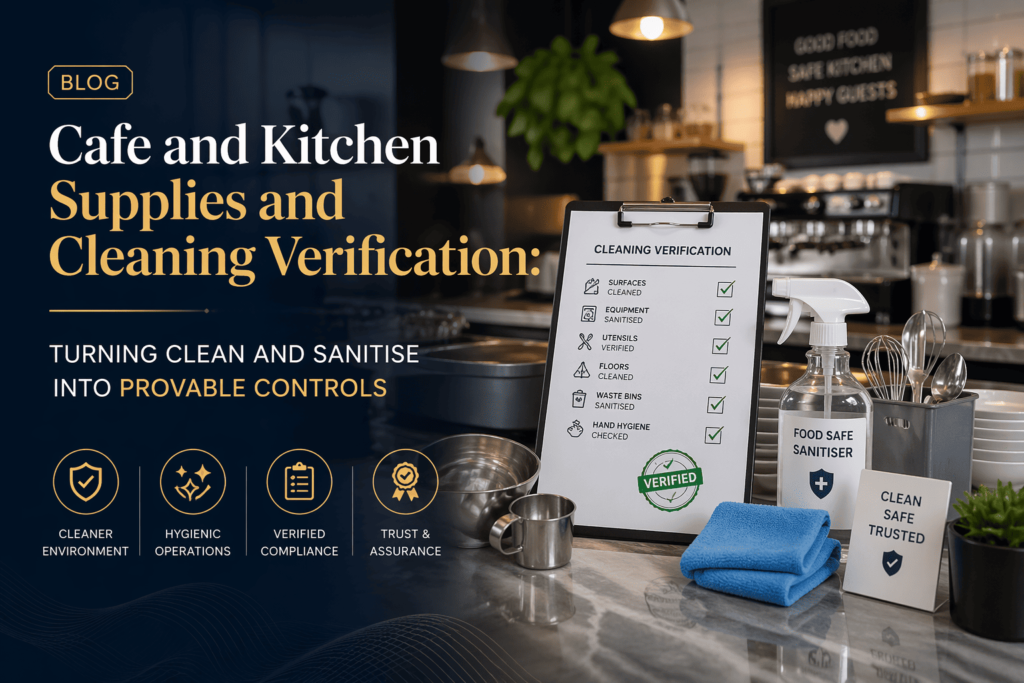

As authorities demand more verification of sanitation results, cafe supplies and cleaning systems are being scrutinised more closely throughout Australia’s food service industry. Cafes are now expected to demonstrate that sanitisation and cleaning procedures are effective in practice rather than just completing standard chores.
Standard 3.2.2A became enforceable in December 2023. It introduced substantiation requirements for critical food safety controls. Businesses handling ready-to-eat food must now prove their cleaning and sanitising practices reduce contamination to safe levels. Visual inspection alone no longer satisfies regulatory expectations.
The Evidence Gap in Traditional Cleaning Protocols
Food Standards Australia New Zealand distinguishes clearly between cleaning and sanitising. Cleaning removes visible dirt and grease using detergent and water. Sanitising applies heat or chemicals to destroy microorganisms. Verification proves both processes achieved their intended outcome.
This distinction matters because surfaces can appear pristine while harbouring dangerous bacterial levels. Traditional cleaning protocols rely on process compliance rather than outcome measurement. An operator follows steps and completes documentation. The assumption of safety follows. Regulators increasingly reject this assumption-based approach.
The NSW Food Authority emphasises that businesses must actively monitor key risks related to food processing and temperature control. This monitoring requires objective measurement tools. Subjective visual assessments no longer suffice.
ATP Testing: The Science Behind Verification
Adenosine triphosphate testing provides quantifiable cleanliness measurements through bioluminescence technology. ATP is an energy molecule present in all living cells. Its presence on sanitised surfaces indicates biological contamination. Testing devices use enzyme reactions to measure ATP levels as Relative Light Units (RLUs).
The process involves three steps:
- Swabbing the target surface
- Activating the testing device to trigger the enzyme reaction
- Reading results through a luminometer
Total time from sample collection to result typically measures ten seconds.
Industry standards for food service environments establish RLU thresholds below 50. This stringent benchmark reflects serious risks associated with food contact surfaces in commercial kitchens. Preparation benches and utensils require rigorous verification. Equipment touching ready-to-eat food demands the highest attention.
Research demonstrates 60 to 90 percent correlation between RLU and colony-forming unit readings. Environmental conditions affect this correlation. While ATP testing cannot differentiate between microbial and non-microbial organic matter, elevated readings consistently indicate inadequate cleaning or sanitising.
Building Evidence-Based Cleaning Systems
Implementing verification protocols requires infrastructure beyond traditional cafe supplies. Australian cafes need calibrated luminometers and testing swabs. Food-safe detergents and approved sanitisers remain essential. Documentation systems complete the required toolkit.
Commercial dishwashers exemplify verification necessity. Equipment must reach 71°C final surface temperature to properly sanitise items according to Food Standards Australia New Zealand specifications. Temperature verification confirms equipment functions correctly rather than assuming compliance.
Complete Wholesale Suppliers reports increased demand for verification equipment as cafes respond to regulatory changes. Entry-level ATP systems cost between $1,500 and $3,000 for luminometers. Individual test swabs are priced around $5 to $8. Small cafes conducting 20 to 30 weekly tests allocate approximately $150 to $200 monthly for supplies.
These costs appear substantial until compared against non-compliance consequences. Fines for food safety violations reach tens of thousands of dollars. Foodborne illness outbreaks carry legal liability and reputational damage. Potential closure looms as a worst-case scenario. One contamination incident typically costs more than years of verification supplies.
Five-Step Implementation Framework
1. Map Critical Control Points
Systematic risk assessment identifies surfaces requiring verification priority. Food contact surfaces including preparation benches and cutting boards demand highest attention. High-touch areas like door handles and tap controls follow. Point-of-sale equipment also requires regular testing. Environmental mapping should align with HACCP principles identifying hazard control points.
2. Establish Baseline Thresholds
Industry standards suggest RLU readings below 50 for food service. Individual cafes must establish context-appropriate thresholds nonetheless. Newly sanitised stainless steel surfaces should register near zero. Textured equipment surfaces might show marginally higher readings when properly cleaned. Documentation should record threshold decisions and supporting rationale.
3. Develop Staff Competency
Consistent swabbing technique determines result reliability. Training protocols must address sample collection without contamination. Proper device activation timing matters significantly. Staff must understand result interpretation. Critical protocols include response procedures when tests exceed thresholds. High ATP readings require immediate recleaning and retesting before food preparation resumes.
4. Create Documentation Infrastructure
Food Standards Australia New Zealand provides templates for recording cleaning and sanitising activities. Digital cloud-based systems work well. Paper records remain acceptable alternatives. Documentation must capture test locations and RLU results. Staff identification and timestamps are mandatory. Corrective actions require notation. This evidence becomes crucial during regulatory inspections.
5. Integrate Into Operational Routines
Verification succeeds when embedded within existing workflows. Pre-service testing confirms overnight cleaning effectiveness. Mid-shift spot checks detect contamination before spread. End-of-day comprehensive verification ensures compliant closure. Scheduled integration prevents verification from disrupting service operations.
Common Implementation Challenges
Australian cafes adopting ATP testing encounter predictable obstacles. Testing unclean surfaces produces meaningless results since verification follows cleaning and sanitising steps. Some operators initially test before cleaning. They expect high readings to justify protocols. This approach wastes supplies without providing compliance value.
Inconsistent swabbing technique skews measurements. Excessive pressure damages swabs. Insufficient contact misses contamination. Rushed activation or incorrect insertion prevents proper enzyme reactions. Competency requires hands-on practice until technique standardises.
Equipment calibration significantly impacts accuracy. Luminometers require regular verification against control standards. Improper storage temperatures affect reagent stability. Manufacturer specifications constitute non-negotiable requirements.
Complete Wholesale Suppliers emphasises documentation consistency as a frequent challenge. Operators sometimes conduct tests without recording results. This negates verification value during inspections. Systematic recording protocols must accompany testing procedures.
Economic Considerations and Risk Management
Consumer behaviour research indicates 75 percent of diners avoid returning to establishments with poor hygiene. Food quality becomes secondary. Eighty-six percent identify cleanliness as the primary factor influencing repeat visits. Failed health inspections or negative hygiene reviews severely impact customer retention.
The Australian Institute of Food Safety reports 60 percent of new cafes fail within their first year. Compliance issues and operational problems frequently contribute to closure. Proper systems prevent these failures. Verification protocols address both regulatory requirements and operational efficiency.
ATP testing enables targeted cleaning by identifying actual problem areas. Resources focus where attention is truly needed. This precision approach optimises labour allocation while maintaining superior safety standards. Uniform deep cleaning across all surfaces becomes unnecessary.
Regulatory Trajectory and Industry Adaptation
Food safety regulations continue evolving toward greater transparency and documentation. From July 2026, businesses serving ready-to-eat seafood must provide customers with country of origin information. Standardised labelling systems will facilitate this requirement. This signals regulators’ increasing focus on verifiable data.
The trajectory favours early adoption of verification technology. As ATP testing becomes standard industry practice, operations relying solely on visual inspection will struggle meeting compliance expectations. Proactive implementation positions cafes ahead of regulatory curves. Reactive scrambling becomes unnecessary.
Environmental Health Officers increasingly expect ATP data during inspections. Documented verification records demonstrate systematic safety management beyond minimum compliance. This evidence often influences inspection outcomes. Scrutiny intensity typically reduces when proper documentation exists.
Industry suppliers report substantial growth in verification equipment inquiries. Cafes recognise compliance evolution is underway. Professional cafe supplies now encompass verification equipment alongside traditional cleaning products as essential operational infrastructure.
Professional Standards and Public Health
Cleaning verification represents more than regulatory compliance. The transition from assumption-based cleaning to evidence-based verification fundamentally strengthens public health protection. Modern cafe supplies include verification equipment as essential operational infrastructure alongside traditional cleaning products.
Standard 3.2.2A codifies what food safety professionals have long understood. Effective cleaning cannot be assumed without measurement. ATP testing provides objective data confirming that cleaning and sanitising protocols achieve their intended purpose.
Cafes succeeding in Australia’s evolving regulatory environment recognise that compliance standards have permanently shifted. Verification isn’t supplementary work added to cleaning routines. It constitutes the evidence that cleaning routines actually work.
As 2026 progresses, the distinction between compliant and non-compliant operations increasingly aligns with verification capability. Cafes investing in proper training infrastructure and systematic documentation position themselves for sustainable operation. Those maintaining traditional approaches face mounting regulatory and operational challenges.
The evidence is clear: verification technology transforms cleaning from a trust-based process into a provable control. For Australian cafes, this transformation is no longer optional.